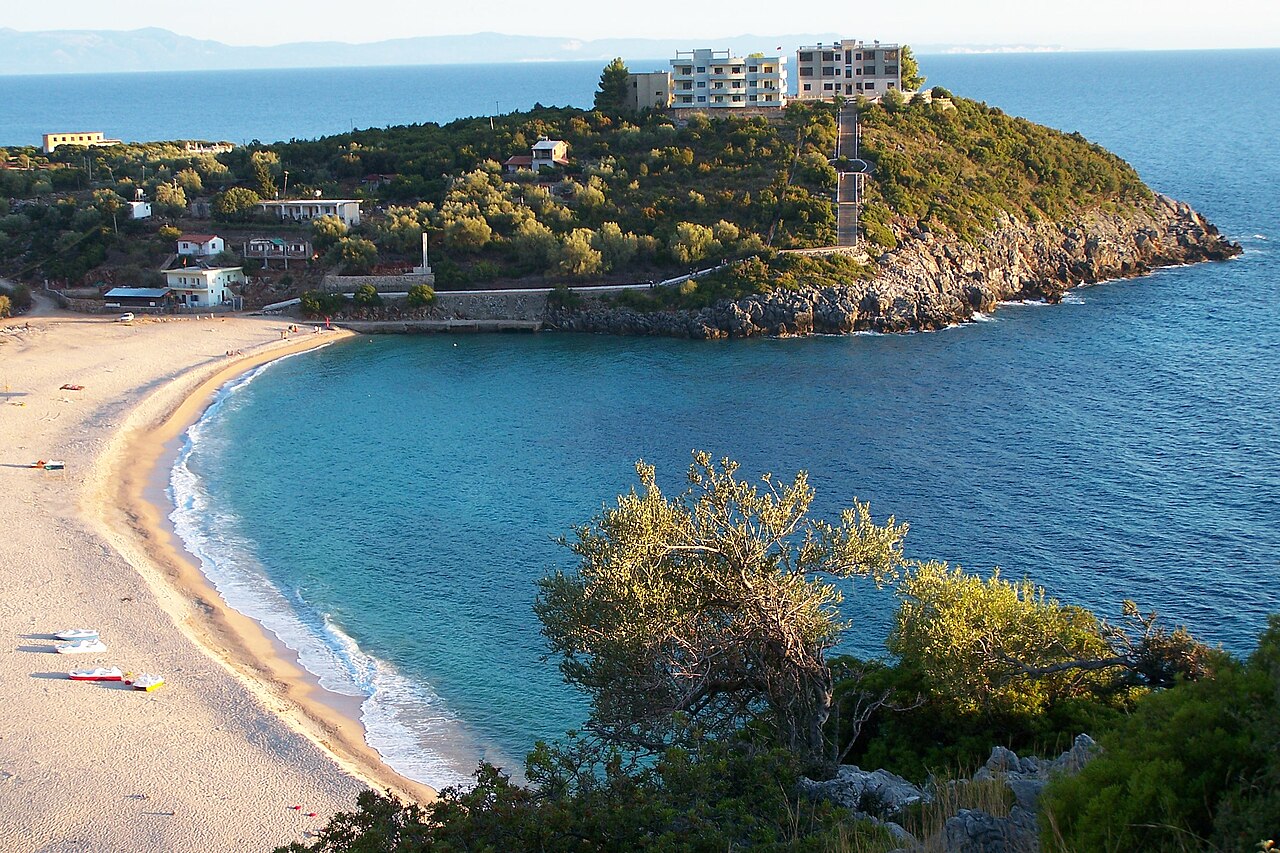
From the turquoise Ionian coast to wild rivers, hidden springs, and ancient glacier lakes — Albania's waters are among Europe's most spectacular and least-explored.
Albania has 362 km of Adriatic and Ionian coastline, over 120 lakes, and dozens of major rivers — including the Vjosa, now protected as Europe's only wild-river national park. Whether you want to snorkel in crystal Mediterranean coves, raft a pristine canyon, or float in a surreal blue spring, Albania delivers.
Stretching from Vlorë south to Sarandë, the Albanian Riviera is one of the Mediterranean's last great undiscovered coastlines. The water is Ionian-clear — turquoise in the shallows, deepening to sapphire — and many beaches remain uncrowded even in summer.
Dhermi is the Riviera's most popular beach town, with a long pebble beach, beach bars, and a charming hilltop old town above. Himara sits beneath dramatic cliffs with several distinct cove beaches nearby. Ksamil, just north of the Greek border near Sarandë, offers four small sandy islands reachable by a short swim — it's the closest thing Albania has to a Greek island experience.
The rocky seabed makes much of the Riviera excellent for snorkeling. Visibility regularly exceeds 15–20 metres. Diving operators are beginning to establish themselves in Himara and Sarandë.
A few of the best spots along the coast
One of Albania's most extraordinary natural phenomena, the Blue Eye (Syri i Kaltër) is a powerful karst spring south of Sarandë, about 45 minutes east of Gjirokastër. Water erupts from the earth at a rate of roughly 18,400 litres per second, rising from a shaft estimated at over 50 metres deep through a circular pool of impossibly vivid blue.
The spring maintains a constant temperature of around 12°C (54°F) year-round — startlingly cold — and is the source of the 25 km Bistricë River. The surrounding forest is lush and shaded, making it a beautiful place to walk and picnic even in summer heat.
Getting there: From Sarandë, follow the SH99 road toward Gjirokastër. The Blue Eye is signposted near the village of Muzinë. A small entrance fee applies. The site is easily done as a half-day trip from Sarandë or Gjirokastër.
The Vjosa is one of Europe's last large wild rivers — completely free-flowing from its source in the Greek Pindus mountains across 270 km of southern Albania to the Adriatic Sea. It was declared Albania's first national park in 2023, and is the only wild-river national park in all of Europe.
The river offers exceptional kayaking and rafting through gravel bars, braided channels, and canyon sections. Class II–III rapids make it approachable for most skill levels in the right conditions. The spring months (April–May) bring higher flows and more excitement; late summer offers calmer, more relaxed paddling.
Beyond paddling, the Vjosa supports extraordinary biodiversity: its gravel bars are nesting habitat for rare birds, and the river hosts endemic fish species found nowhere else on Earth. Multi-day kayak expeditions with camping on river islands are possible and increasingly popular.
Lake Ohrid — shared between Albania and North Macedonia — is one of Europe's oldest and deepest lakes, estimated at over 5 million years old and a UNESCO World Heritage Site. Albania's share of the lake borders the town of Pogradec, which offers a pleasant waterfront promenade, swimming beaches, and boat trips across the lake. The lake supports dozens of endemic species found nowhere else on Earth, including the famous Ohrid trout.
Lake Shkodra (Liqeni i Shkodrës) is the largest lake in the Western Balkans, straddling the border with Montenegro. It's a paradise for birdwatchers and kayakers, with vast reed beds, migratory wildfowl, and unspoilt shoreline. The town of Shkodër on its eastern shore is Albania's northern cultural hub and gateway to the Albanian Alps.
The Osumi Canyon near Çorovodë in central Albania is a 26 km limestone gorge with walls rising up to 80 metres. It offers two very distinct seasonal experiences: springtime rafting through churning snowmelt, and summer canyoning through sun-drenched natural pools and caves.
Spring rafting (March–May) is Class II on the Osumi River — accessible to beginners with no prior experience, but exciting with guaranteed splashing. Full-day guided trips include all equipment and typically depart from Çorovodë.
Summer canyoning (June–September) involves hiking in the riverbed, swimming through passages, and rappelling short drops. The canyon reveals sandy banks, caves, and natural swimming pools that are invisible at high water. It's one of Albania's most thrilling day adventures.
Near the charming southern town of Përmet, the Lengarica River flows through the Langarica Canyon — and along its banks bubble natural thermal springs with water temperatures reaching 29°C (84°F). The Benja thermal baths are set in a gorge of dramatic limestone cliffs, making for one of Albania's most picturesque natural bathing spots.
The baths are a short walk from the village of Bënjë, and are typically combined with a visit to the stunning Langarica Canyon — a narrow gorge with crystal-clear river water, rope bridges, and towering rock formations. Përmet itself is renowned as Albania's "City of Flowers" and a centre for ecotourism in the south.
Albania's beaches do not uniformly operate lifeguard services. Check local conditions before swimming, particularly at remote or less-visited coves. Currents along the Riviera can be unpredictable, especially near headlands.
Never enter rivers after heavy rainfall — water levels and currents can rise dramatically within hours. The Vjosa, Osumi, and Lengarica rivers can flash flood. Always check weather forecasts and heed local operator advice.
Boat traffic can be significant near popular beaches in July–August. Use a surface marker buoy (SMB) when snorkeling away from shore. For scuba diving, use only certified local dive operators with up-to-date equipment.
Ensure your travel insurance covers water sports activities and emergency evacuation. Carry any required prescription medications. Nearest hospitals with emergency care are in Sarandë, Vlorë, and Shkodër for the main tourist areas.